
From the hollows of Ohiopyle to the suburban backyards of Allegheny County, Western Pennsylvania is home to a surprising mix of wildlife. Test your knowledge of our feathered and four-legged friends with this quiz featuring nature photography by our very own Oliver Eickelberg, MD.
Take a walk on the wild side, and see how many animals you can identify.
Take the Quiz!
Hover over (or tap if on mobile) the empty space below each question to reveal the correct answer. Let’s go!
•••


BLACK BEAR (Ursus americanus)
Black bears are famous for “denning up” for the winter, but they aren’t true hibernators. What is the biggest difference in how a bear spends its winter?
A. They must wake up every 24 hours to drink water.
B. Their body temperature only drops slightly, allowing them to wake up quickly if disturbed.
C. They spend the entire winter hunting for small rodents in the snow.
D. Their heartbeat stays around 55 beats per minute.

B. Their body temperature only drops slightly, allowing them to wake up quickly if disturbed. Because their temperature stays relatively high, mother bears actually give birth to their cubs in the middle of winter (usually in January) and nurse them while in a state of semi-sleep until spring arrives.
BARRED OWL (Strix varia)
Barred owls are expanding their range, but they are most famous for their distinctive call. What does it sound like they are saying?
A. “Drink your tea!”
B. “Who cooks for you? Who cooks for you-all?”
C. “Cheerily, cheer up!”
D. “Fee-bee, fee-bay”
B. “Who cooks for you? Who cooks for you-all?” First described by Philadelphia naturalist Benjamin Smith Barton in 1799, the barred owl is known for their classic rhythmic hoot. Listen


BELTED KINGFISHER (Megaceryle alcyon)
Where do belted kingfishers typically build their nests in the PA landscape?
A. High in hemlock trees
B. In burrows dug into dirt banks along water
C. Inside abandoned woodpecker holes
D. On floating mats of vegetation
B. In burrows dug into dirt banks along water. One of the few species where the female is more colorful than the male, belted kingfishers dig tunnels up to 8 feet long into riverbanks.
EASTERN GREY SQUIRREL (Sciurus carolinensis)
Roughly how many nuts can a single eastern grey squirrel bury in a single season?
A. 100
B. 1,000
C. 10,000
D. Over 100,000+
C. Named from the Greek Sciurus, which combines skia (“shadow”) and oura (“tail”) for the way they sit beneath their bushy tails, eastern grey squirrels are prolific hoarders, burying thousands of nuts and later rediscovering them by scent.


RED-TAILED HAWK (Buteo jamaicensis)
You’ve definitely heard a red-tailed hawk, even if you didn’t realize it. Why is their scream so famous?
A. It is used as the sound for bald eagles in movies.
B. It can be heard from over five miles away.
C. It mimics the sound of a police siren.
D. It sounds exactly like a human whistle.
A. It is used as the sound for bald eagles in movies. Hollywood uses the “cool” red-tailed hawk scream because eagles actually sound like “chirping” wimps.
Have a listen: Red-tailed hawk vs. bald eagle
DARK-EYED JUNCO (Junco hyemalis)
Juncos are famous for arriving in PA backyards just as the weather turns cold. Where do most of them go during the hot humid Pittsburgh summers?
A. They stay in PA but hide in caves.
B. They migrate further south to Florida.
C. They head north to the Canadian forests or high Appalachians.
D. They lose their feathers and turn bright green to blend in.
C. They head north to the Canadian forests or high Appalachians. Often nicknamed “snowbirds,” dark-eyed juncos prefer the cooler boreal forests for breeding.


Pennsylvania has just one species of otter: the river otter. Which of the following about river otters is false?
A. They can dive to depths of 60 feet and swim up to 8 miles per hour.
B. They have waterproof fur, webbed feet, and can close their ears and nostrils to keep water out while underwater.
C. They use their whiskers to find prey in muddy water.
D. Their left lung is larger than the right.
D. Their left lung is larger than the right. Just like in humans, the right lung of an otter is larger than the left. With four lobes on the right and two on the left, their lung structure helps them hold their breath for up to 8 minutes.
RUFFED GROUSE (Bonasa umbellus)
Pennsylvania’s state bird, the ruffed grouse, is known for a drumming sound that echoes through woods in the spring. How do they make this sound?
A. By pecking rapidly on hollow logs.
B. By beating their wings against the air very fast.
C. By kicking dry leaves with their feet.
D. By rubbing their beak against their chest feathers.
B. By beating their wings against the air very fast. One of ten species of grouse native to North America, the ruffed grouse is known for their drumming sound, an acoustic sonic boom created by rapid wing-beating that can be heard for a quarter-mile or more. Listen


NORTHERN CARDINAL (Cardinalis cardinalis)
While most cardinals in the Pittsburgh area are brilliant red or soft brown, a very rare genetic mutation can occasionally be spotted in Western PA. What color is a cardinal with this xanthochroism condition?
A. Burnt orange
B. Pure white (albino)
C. Jet black
D. Bright yellow
D. Bright yellow. This rare genetic variation prevents the bird from converting yellow pigments from its food into red, resulting in a yellow cardinal instead of usual bright red cardinals, so named for the distinctive robes and caps worn by Roman Catholic cardinals.
The official state animal of Pennsylvania, white-tailed deer delight in feasting upon hostas, roses, and tulips across the Pittsburgh area. However, what is their preferred “power food” in the Western PA wilderness during the fall?
A. Pine needles
B. Wild mushrooms and lichen
C. Acorns
D. Field corn only
C. Acorns. Deer are concentrate selectors, meaning they pick the most nutrient-dense parts of plants to eat. A single adult deer needs to consume about 6 to 8 pounds of greenery and nuts, such as acorns or “mast,” every day to maintain its weight heading into winter.


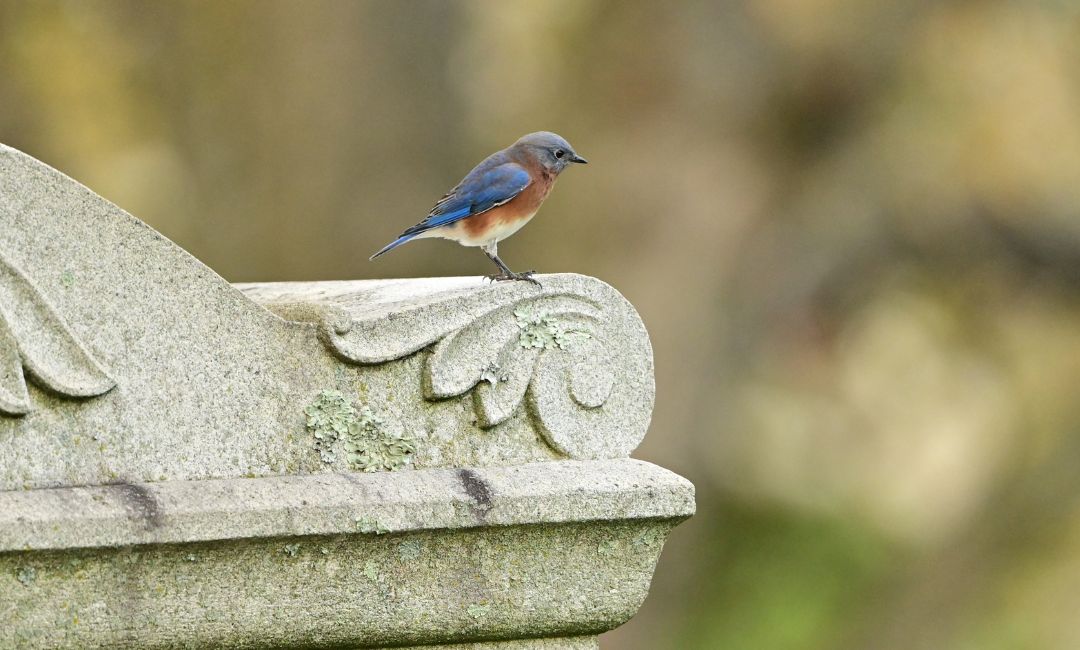
In Western Pennsylvania, where are you most likely to find eastern bluebirds nesting?
A. In hanging nests made of mud and grass
B. In abandoned woodpecker holes or man-made nest boxes
C. Under the eaves of suburban porches
D. Directly on the forest floor hidden by ferns
B. In abandoned woodpecker holes or man-made nest boxes. Eastern bluebirds are secondary cavity nesters, meaning they cannot drill their own holes in trees. Because bluebirds aren’t equipped to excavate their own homes, they rely heavily on “Bluebird Trails,” lines of man-made boxes maintained by volunteers that helped the species rebound after populations plummeted in the mid-20th century.
Great horned owls are famous for the two prominent tufts of feathers on their heads that look like ears or horns. What is the actual purpose of these “plumicorns”?
A. They help the owl communicate its mood and break up its silhouette.
B. They are the owl’s actual ears used for pinpointing sound.
C. They act as antennae to sense changes in wind direction.
D. They are only grown by males to attract mates.
A. They help the owl communicate its mood and break up its silhouette. Plumicorns have nothing to do with hearing (The great horned owl’s actual ears are hidden lower on the sides of the head). Rather, these tufts help the owl blend into the jagged bark of Pennsylvania’s oak and hickory trees by masking the round shape of their heads.


GROUNDHOG (Marmota monax)
Groundhogs are one of the few true hibernators in Western Pennsylvania. While a black bear might wake up on a warm January day, what happens to a groundhog’s heart rate when it goes into its deep winter sleep?
A. It stays at a steady 80 beats per minute to keep the blood from freezing.
B. It drops significantly, from about 80 beats per minute to just 4 or 5 beats per minute.
C. It fluctuates wildly every hour to mimic a shivering effect for heat.
D. It slows down only during the night and returns to normal during the day.
B. It drops significantly, from about 80 beats per minute to just 4 or 5 beats per minute. Also known as a whistlepig or woodchuck (from the Algonquian name “wuchak,” meaning “digger”), the groundhog is a staple of Western Pennsylvanian fields and roadsides. During hibernation, a groundhog’s body temperature plummets from 37°C (99°F) to as low as 3°C (37°F), allowing them to survive for months solely on the thick layer of body fat they spent all summer building up.
BLUE JAY (Cyanocitta cristata)
Blue jays are known for their striking color and clever behavior, but their feathers are not actually blue. Their color is due to which natural phenomenon?
A. Bioluminescence
B. Structural coloration
C. Iridescent molting
D. Carotenoid accumulation
B. Structural coloration. If you were to take a blue jay feather and hold it up to a strong backlight, the blue would vanish and the feather would look brownish-grey. The internal structure of the feather scatters light in a way that only reflects the blue wavelength (a phenomenon called Tyndall scattering), so if the structure is destroyed, the blue disappears.


The great grey owl is often called the largest owl in North America, but if you saw one perched on a hemlock branch in Northwestern PA, its size may deceive you. Why?
A. They are about 70% feathers and actually weigh less than a great horned owl.
B. They can puff up their skin like a pufferfish.
C. Their wingspan is actually smaller than a crow’s.
D. They only look large when they are flying toward you.
A. They are about 70% feathers and actually weigh less than a great horned owl. Commonly referred to as the “Phantom of the North,” the great grey owl is mostly fluff despite standing nearly 2 to 3 feet tall (Great horned owls actually outweigh them by a significant margin).
After the last native elk was killed in 1867, Pennsylvania began a massive reintroduction effort, with elk reintroduced to the Allegheny National Forest and northcentral PA between 1913 and 1926. From where did the majority of these 177 elk come?
A. Private game farms in New York
B. The Canadian Rockies
C. Yellowstone National Park
D. The Great Smoky Mountains
C. Yellowstone National Park. Because the native eastern elk, or “wapiti,” was extinct, Pennsylvania conservationists brought in Rocky Mountain elk via train cars. Today, that original group has grown into a thriving population of over 1,400 animals, making it the largest wild elk herd east of the Mississippi River.


AMERICAN ROBIN (Turdus migratorius)
We’ve all heard that “the early bird catches the worm,” but if you are sitting on your porch in the wee hours of the morning, you may notice that robins are active before almost any other winged creature. Why are they among the first birds to start singing in the morning?
A. They have larger eyes that are more sensitive to low light.
B. Their body temperature is naturally higher, allowing them to wake up faster.
C. They prefer to forage before the morning dew evaporates from the grass.
D. They are more resistant to the cold morning air than smaller songbirds.
A. They have larger eyes that are more sensitive to low light. Because their eyes are physically larger and have more light-sensitive cells, robins can see well enough to hunt for worms and defend their territory while it is still too dark for predators like hawks to fly or for smaller birds to see their own food.
Peregrine falcons are the fastest birds in the world, flying regularly at 60 mph and reaching speeds over 200 mph when entering their high-speed hunting dive. What is this hunting dive called?
A. Swoop
B. Plunge
C. Stoop
D. Glide
C. Stoop. Peregrine falcons fold their wings to dive steeply toward their prey, using gravity and aerodynamic precision to strike the prey in mid-air.
Follow along with the Peregrine falcons nesting at the Cathedral of Learning with the National Aviary Peregrine FalconCam: https://www.aviary.org/birds-habitats/live-streams/


Photo credit: Tom Altany

Photo credit: smcarter
BOBCAT (Lynx rufus)
The only native wildcat in Pennsylvania, the bobcat is the mascot of which Pitt regional campus?
A. Pitt-Bradford
B. Pitt-Johnstown
C. Pitt-Titusville
D. Pitt-Greensburg
D. Pitt-Greensburg. If you ever catch a close look at this elusive creature, you’ll notice long ruffs of fur on the bobcat’s cheeks. Aside from making them look larger, these ruffs help funnel sound towards the bobcat’s ears, making them one of the most effective auditory hunters in the PA woods.


View more nature photos by Dr. Eickelberg on Instagram: @oliver.eickelberg