
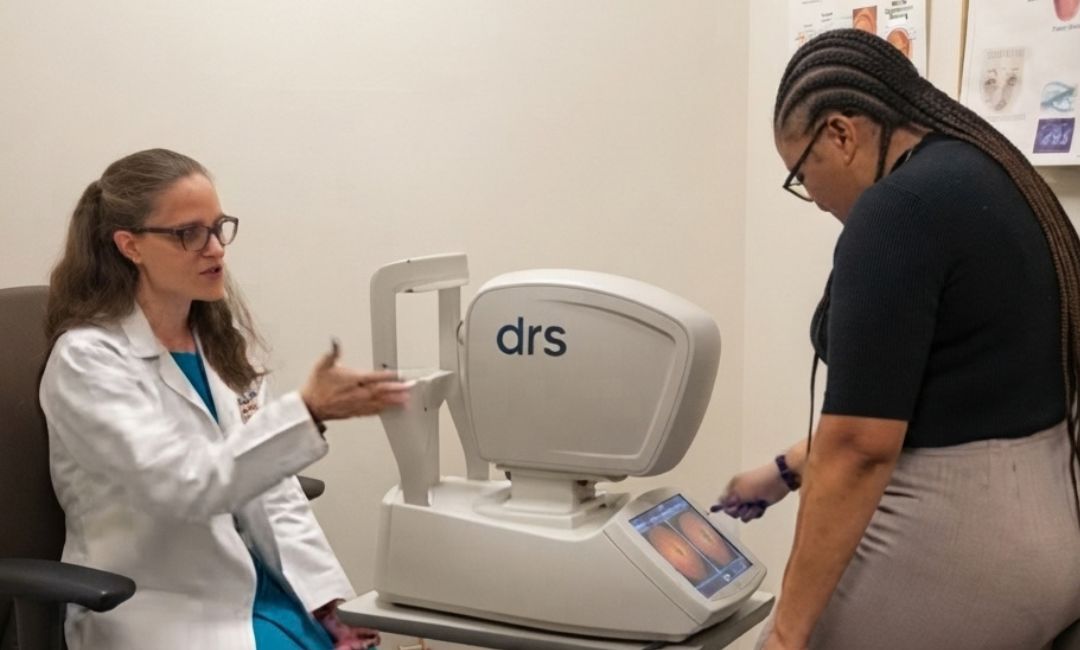
Digital Retina Imaging performed by Dr. Kristen Ehrenberger at PERC.
What happens when patients with complex medical needs outgrow pediatric care? For 20 years, the Progressive Evaluation & Referral Center (PERC) has helped patients and families navigate that transition while building a medical home where they can find the specialized support they need.
For adults with complex medical needs or developmental disabilities, transitioning from pediatric to adult health care can be more than a change in doctors. It can mean navigating an unfamiliar health care system, finding specialists who understand their conditions, and coordinating care that may span multiple hospitals, clinics, and providers. Helping patients and families navigate that transition has been at the heart of PERC’s mission for two decades. This year, the program celebrates its 20th anniversary, marking 20 years of providing a medical home for patients who may otherwise struggle to find care.
PERC was founded by Alda Maria Gonzaga, MD, MS, after she completed medical school, a Med-Peds residency, and a master’s degree in medical education right here at Pitt. She established PERC in response to a growing need: young people who had survived serious childhood illnesses and medical challenges were aging into adulthood but often struggled to find adult providers equipped to care for them. While pediatric and adult health care systems often operate separately, many medically complex patients continue to need specialized care well into adulthood. Many adult specialists may not have experience with childhood-onset conditions, developmental disabilities, or the unique needs of patients transitioning from pediatric care.
“PERC was imagined as a waystation to helping medically complex and/or developmentally disabled young adults find care ‘on the adult side,'” said Kristen Ehrenberger, MD, PhD, Director of PERC.
Initially, Dr. Gonzaga expected to care for well-defined patient populations, such as individuals with cystic fibrosis or sickle cell disease. Instead, PERC evolved to serve a wide variety of patients, including those with cerebral palsy, autism, intellectual disabilities, and less common genetic conditions.
What began as a program intended to help patients transition to adult primary care became something more lasting. As Gonzaga struggled to find adult primary care providers for her patients, she ended up keeping many of them at PERC.
Today, PERC has grown from its early days of just two physicians to a team of four physicians, a nurse care manager, and additional administrative and support staff. The program serves patients across its Oakland and GIM-South locations in West Mifflin. And, although the program has grown, its mission remains unchanged: to provide compassionate, flexible, and comprehensive primary care to patients who may have difficulty finding it elsewhere.
“We do this because we love our patients and their families, we celebrate their successes, and we show up to advocate for them when the system lets them down,” Dr. Ehrenberger said.
PERC’s Med-Peds physicians, who complete training in both internal medicine and pediatrics, bring a unique perspective to the care of adults with complex medical needs. Their training in caring for medically complex children means they aren’t fazed by rare genetic conditions, patients who can’t swallow pills, or the need to communicate with caregivers instead of the patient directly.
“We try to be flexible, out-of-the-box problem solvers,” Dr. Ehrenberger said.
That flexibility is central to PERC’s approach. The program serves as a primary care home of last resort for patients who may have been turned away by other providers because of the complexity of their medical needs.
For PERC patients, receiving care often involves much more than a traditional primary care appointment. The team helps coordinate care across specialties, navigate referrals, and address challenges that can make accessing health care difficult. This may include connecting patients with adult specialists, communicating with pediatric and adult providers, coordinating testing and appointments, and helping bundle care when possible. For patients who require sedation for procedures, coordinating blood work, vaccines, imaging, or dental care can be especially important. The team also assists with guardianship paperwork, durable medical equipment orders, and medical decision-making support for caregivers.
These responsibilities reflect a broader challenge in adult medicine: patients and families are often expected to coordinate complex care on their own.
“Too often in adult medicine, the patient has to be their own care coordinator,” Ehrenberger said. “Remember their problems, medications, specialists, tests, etc.”
For patients with complex medical needs – and for caregivers managing care on their behalf – that responsibility can quickly become overwhelming. “It really takes a village,” Ehrenberger said.
The impact of PERC’s work can be seen in the experiences of the patients and families it serves.
Ehrenberger shared the story of Jacob, a patient with cerebral palsy, mild intellectual disability, and a sense of humor that became well known through his “Jokes with Jacob” YouTube videos. As Jacob grew older, his family faced challenges finding appropriate care. He had physically outgrown the examination tables at Children’s Hospital of Pittsburgh, and the transition to adult care had not been fully prepared for. During the COVID-19 pandemic, his family was unsure where to turn for his medical needs.
A pediatrician at the Complex Care Center, Jennifer Baldwin, MD, discovered Jacob’s videos while watching them during quarantine. After learning that his family was struggling to find care, she helped facilitate his transfer to PERC. For Jacob and his family, the connection provided a path forward during a difficult transition.
Stories like Jacob’s illustrate why programs such as PERC are needed – and how a health care system that is flexible, coordinated, and responsive to individual needs can make such a meaningful difference.
As the population of adults with complex medical needs continues to grow, PERC’s work is more important than ever. Ehrenberger anticipates that the program will need to continue adding physicians, expanding care coordination, and strengthening its referral network.
The team is also exploring the possibility of adding video consultation services for patients who live farther from Pittsburgh and already have a local primary care provider. These consultations could help patients and families identify adult specialists, navigate guardianship questions, and address other complex needs.
Another priority is developing a referral pathway for bundled, sedated care. For patients who cannot safely or comfortably undergo procedures such as blood draws or vaccinations while awake, coordinating multiple services during a single sedation opportunity could help prevent deferred care.
Dr. Ehrenberger also hopes to establish a Transitions Taskforce on the adult side of medicine, modeled after the one on the pediatric side. The goal would be to bring together professionals from different fields to share resources, troubleshoot challenges, and find new ways to help patients and families bridge the gaps between pediatric and adult care.
While PERC’s model is unique, Dr. Ehrenberger believes other health systems can learn from its approach. Two of the most important lessons, she said, are the value of longer visits and providing support between appointments. Longer visits are crucial because they leave time to address not just acute needs but also to piece together a work-up or think about long-term planning. Support between visits helps patients and caregivers complete forms, coordinate testing, and follow through with specialist referrals.
At the center of it all is a commitment to making health care more accessible and responsive for patients with complex needs.
“PERC isn’t just the doctors,” Dr. Ehrenberger said, emphasizing the contributions of the nurses, medical assistants, administrative staff, and other team members who help care for patients every day.
As PERC celebrates 20 years, its continued success reflects the dedication of its team and the importance of creating a health care system where every patient has a place to turn, and as it looks to the next 20 years, PERC will continue to build that place: one patient, one family, and one connection at a time.