
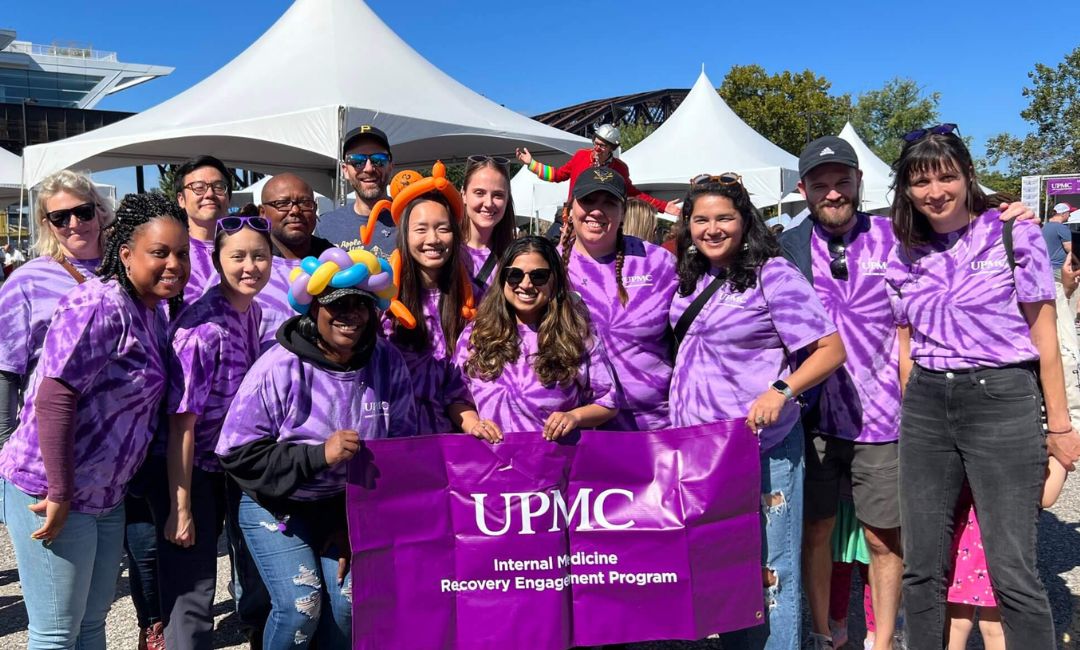
Internal Medicine-Recovery Engagement Program (IM-REP) team at the 2023 Pittsburgh Recovery Walk
Over the past decade, addiction medicine has shifted from a misunderstood field into one where remarkable strides have been made towards understanding addiction and developing effective strategies for its prevention and treatment. At the forefront of this transformation is the Section of Treatment, Research, and Education in Addiction Medicine (STREAM) in the Division of General Internal Medicine, where investigators are helping lead that transformation through new scientific advances, deeper community engagement, and an urgent need to translate evidence into real-world impact.
Despite these recent advances, addiction research still faces a significant funding gap compared to other chronic conditions. That gap is especially visible in Appalachia, where geography, economic conditions, and limited access to care combine to shape substance use outcomes. While national overdose death rates have begun to decline, mortality remains high in parts of Western Pennsylvania and West Virginia.
The tragedy of these high mortality rates is compounded by the fact that highly effective treatments exist, with medications such as buprenorphine that can reduce overdose deaths, all-cause mortality, and suicide risk by more than 50%. But, overdose deaths are still persistently high in Appalachia. “Unfortunately, a minority (<20%) of patients access these lifesaving medications,” says Dr. Jane Liebschutz, chief of the Division of General Internal Medicine (DGIM), “and barriers to treatment are even greater in rural and under-resourced communities.”
To bridge this gap, STREAM investigators play a central role in the NIDA Clinical Trials Network (CTN) Appalachian Node, a multi-institutional collaboration that includes the University of Pittsburgh, West Virginia University, Penn State, and the University of Maryland, Baltimore. Led by principal investigators, Drs. Jane Liebschutz and Erin Winstanley, the Appalachian Node provides the infrastructure to conduct multi-site clinical trials across diverse settings (rural, urban, and post-industrial), allowing researchers to study how local context shapes both substance use patterns and treatment effectiveness. It also enables Pitt to serve as a key site for nationally led trials, accelerating the translation of new interventions into clinical practice.
STREAM researchers emphasize the importance of patient-centered research. Nowhere is that more evident than in the TREETOP Research Center, which focuses on individuals with co-occurring OUD and chronic pain, a population that often falls through the cracks of a siloed health care system. In a recent study led by Dr. Megan Hamm, TREETOP investigators identified key barriers shaping treatment through qualitative interviews with patients and clinicians. Many patients reported experiencing stigma in clinical and community settings, being labeled as “drug-seeking” or “manipulative,” and encountering fragmented care that fails to address both pain and addiction simultaneously.
“Stigma can interfere with availability for individuals to access care for substance use disorders due to structural issues,” notes Winstanley. “One local example was a landlord who evicted UPMC’s methadone clinic from its Wilkinsburg neighborhood location, and the clinic was unable to find an appropriate site to relocate to.”
These “Not in my backyard (NIMBY) policies” create barriers to care for those that need it most, resulting in decreased access in not only residential neighborhoods, but also healthcare institutions that fear other patients may be driven away by individuals with OUD seeking treatment.
Overcoming these challenges requires sustained outreach and partnership. Engaging with policymakers at the local, state, and national levels enables research to be translated into real-world change. DGIM faculty are actively collaborating with state leaders to modernize regulations, such as protections for organizations that test local drug supplies, ensuring that policy keeps pace with evolving public health needs.
“One of the neat things about academic addiction medicine is that we can test novel ways of managing substance use and then spread it from there,” says Winstanley. “Our clinical trials implemented in clinical research sites means that we are training a whole bunch of clinicians and staff in new ways of doing things, who often continue the best practices after the study is over.” Clinical trials themselves then become vehicles for change, training clinicians in new models of care that often persist long after studies conclude.
Beyond applying lessons learned within the clinical trials themselves, STREAM also supports an ACGME-accredited addiction medicine fellowship, along with clinical rotations for students, residents, and advanced practice trainees. “Tomorrow’s addiction researcher will need to integrate multiple treatment modalities, such as medications, neuromodulators and behavioral treatment to identify best methods for treatment success with addiction,” says Liebschutz. Formal clinical training is complemented by research opportunities across the division, including a summer program for first-year medical students and NIH-funded training programs, including the T32 BUILD-UP and K12 PittCATS awards. These clinical and research opportunities are cultivating a new generation of addiction scientists equipped to work across disciplines.
However, much of this progress depends on federal investment. Networks like the NIDA CTN and initiatives such as NIH HEAL provide critical infrastructure, funding, and collaborative opportunities that sustain both research and care delivery. But, recent events, such as the brief termination (and rapid reinstatement) of thousands of SAMHSA grants, have revealed just how vulnerable behavioral health systems are to funding disruptions. For counties and providers, even short-lived uncertainty can threaten services, staffing, and long-term planning.
At the same time, the swift response from policymakers demonstrated strong bipartisan support for addiction services and research – an encouraging sign for the field. Through working collaboratively across relevant organizations and impacted communities, STREAM investigators are hoping to raise awareness of current federal funding for prevention and treatment services and better articulate the number of people served and use plain language to explain the health benefits.
Yet, despite these hurdles, there is a clear sense of momentum and purpose. Addiction touches nearly every community, often in ways that remain unspoken due to stigma. For those working in the field, including Dr. Liebschutz, that reality is both sobering and motivating.
“It’s incredibly rewarding to know that we are working to not only improve health outcomes for individuals with addiction, but also to reduce the suffering and helping people get their lives back.”