
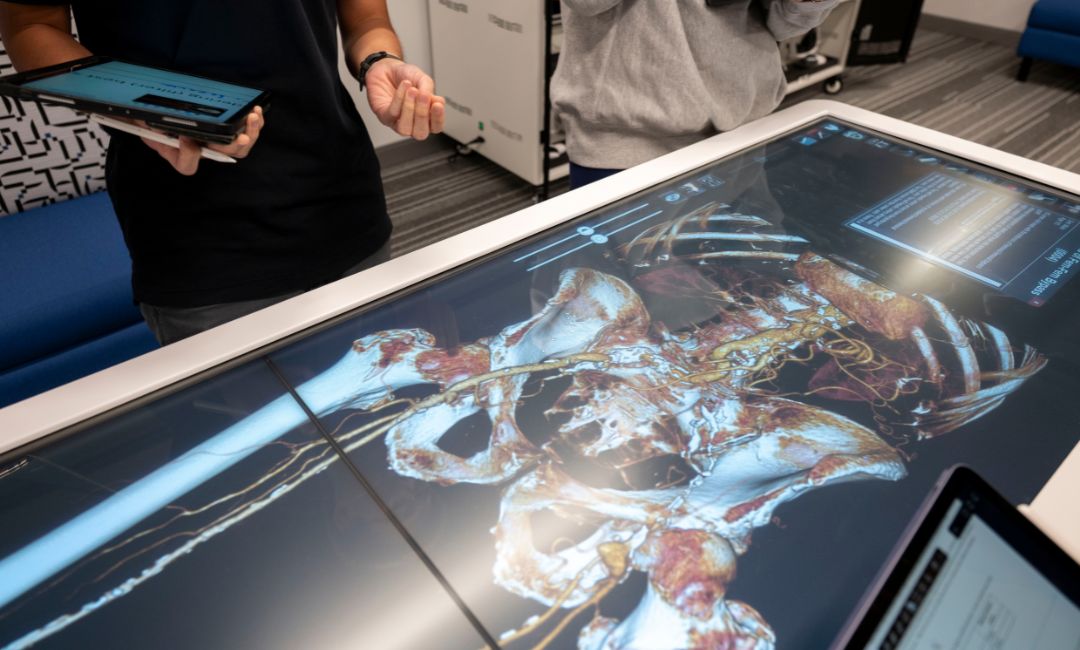
Anatomage table. Photo credit: Tom Altany / University of Pittsburgh
The Health Sciences Library System (HSLS) at the University of Pittsburgh is far more than a place to study or check out books – it’s a modern support hub for Pitt’s health sciences community. With a wide range of services designed to strengthen research, advance education, and improve access to information, HSLS plays an essential role in the everyday work of the Pitt community.
From borrowing materials and accessing course reserves to obtaining journal articles and book chapters through the HSLS Document Delivery Service, the library ensures Pitt’s health sciences community has seamless access to both print and digital collections, even when materials are not immediately available on campus. Beyond access, HSLS librarians provide expert guidance in biomedical research, literature searching, data management, and scholarly communication to enhance the quality and impact of research across campus.
Education is another cornerstone of HSLS’s mission. Faculty librarians lead regularly scheduled workshops on timely topics such as evidence-based searching, research data management, data visualization, scholarly communication and research impact, citation management, instructional and visual design, and molecular biology software. In addition to these classes, HSLS also provides customized instruction tailored to specific groups, departments, or courses, as well as personalized consultations.
Beyond research support, HSLS provides technology lending, collaborative study spaces, and welcoming facilities at Falk Library. One of the newest additions to the library is the Emerging Technology Lab (ETL), designed to bring cutting-edge digital tools into health sciences education. This new space features augmented reality (AR) headsets, virtual reality (VR) headsets, and Anatomage digital cadaveric dissection table. By incorporating extended reality technologies into the learning environment, faculty, staff, and students can engage with immersive, interactive experiences like exploring 3D anatomical models, participating in clinical simulations, and enhancing their understanding of complex concepts in ways that go beyond traditional classroom methods. The Emerging Technology Lab reflects a growing shift towards hands on, technology-driven learning that prepares researchers and clinicals for the future of health care.
Complementing these resources, the Media Production Studio provides professional-grade resources for producing high-quality lectures, podcasts, livestreams, and more. With cameras, microphones, lighting, green screens and editing workstations, Pitt’s health sciences community can create engaging content that appeals to today’s learners.
Through its services, resources, and expert staff, the Health Sciences Library System remains a vital partner in advancing Pitt’s mission of excellence in education, research, and clinical care.