
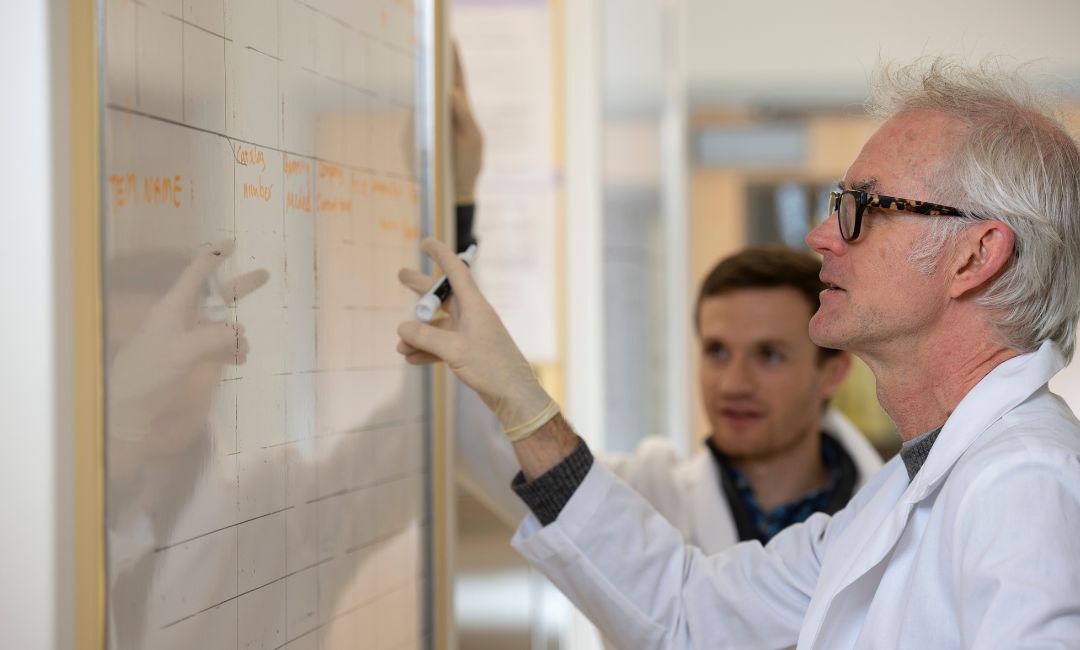
Endo T32 Director, Robert O’Doherty, PhD, and former T32 trainee, Dan Harmon, PhD.
For fifty years, the Endocrinology and Metabolism T32 training program at the University of Pittsburgh has quietly built a legacy of scientific leadership. Continuously funded by the National Institute of Diabetes and Digestive and Kidney Diseases (NIDDK), the Endo T32 program is the longest-running T32 program at Pitt – a distinction reflecting not only longevity, but the division’s sustained ability to evolve alongside a rapidly changing biomedical landscape.
Since 2013, the program has been led by Robert O’Doherty, PhD, who continues a distinguished lineage of leadership that includes Alan Robinson, Frederick DeRubertis, and Andrew Stewart. Under his direction, the program has remained competitive by embracing flexibility and adapting to emerging trends in science and training.
“In my time as Director of Endocrinology and Metabolism T32, we have maintained a commitment to flexibility and adaptation to an everchanging biomedical research environment and taking advantage of opportunities as they arise,” O’Doherty says.
That adaptability is more important now than ever. O’Doherty points to two major shifts shaping the program’s trajectory: the increasing complexity of biomedical research and the growing emphasis on translating discoveries into clinical impact. Today’s trainees don’t just study endocrinology; they engage with experts in immunology, cancer, the microbiome, and heart health to understand how their work changes lives.
This shift is reflected in the day-to-day life of the fellows. From day one, the program moves beyond traditional research by fostering genuine relationships between fellows and mentors, ensuring everyone is aligned around a shared purpose: advancing the trainee’s career with clear direction.
While the curriculum is rigorous, O’Doherty notes that the program’s strength also lies in the character of those it recruits. He says what stands out most about the trainees is simple: “Just a great group of people! They all bring their own personalities, so it’s fun to get to know them. And I can’t remember ever having a negative interaction with any one of them.”
That focus on individual growth carries through to the program’s long-term impact. Alumni consistently view their time in the T32 as a formative period that provides a strong foundation, even as their eventual success reflects their own commitment and talents.
Looking ahead, O’Doherty sees both opportunity and challenge in the same forces that have shaped the program’s success: the expanding relevance of endocrine research across disciplines and the increasing complexity of biomedical science. While these trends open new avenues for discovery, they also require trainees to move beyond traditional silos and engage more broadly across fields.
Ultimately, the program’s mission remains centered on the trainee. “The program is singularly focused on the success of the fellow. By providing an abundance of resources, that are then used appropriately by the fellow during their training, we will prepare the trainee to take the next step on their career path, successfully.”
And, for O’Doherty, the reward is clear. “The singular satisfaction of my role is to see, after a 2-to-3-year period of their hard, focused effort, the success of our trainees in taking the next step in their careers.”